




“IKEA Plan”
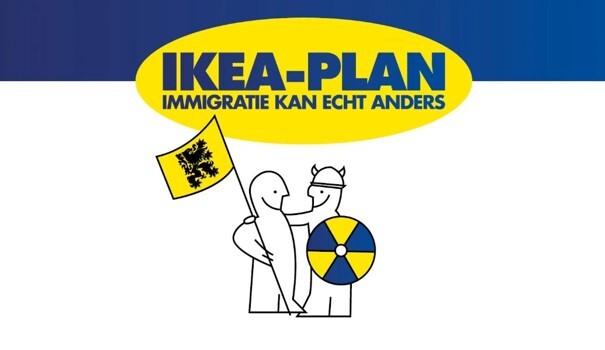
In November 2022, the Belgian political party Vlaams Belang presented its asylum and immigration program at a convention under the name “IKEA Plan – Immigration Can Really Be Different.” The illustrations in the program closely resemble IKEA’s trademarks: the same font, color palette, and illustrations reminiscent of the well-known IKEA assembly instruction booklets.
IKEA subsequently initiates trademark infringement proceedings against Vlaams Belang’s campaign organizer, the Vrijheidsfonds. The Vrijheidsfonds acknowledges the unauthorized use of the trademark but invokes a “valid reason.” In other words, there is a justification rooted in freedom of speech. The trademarks are used to reinforce their own message. Ultimately, the case goes to court.
Intellectual property rights are a “fundamental right”
A trademark right is an intellectual property right recognized as a fundamental right under Article 1 of the Protocol to the ECHR and Article 17(2) of the Charter of Fundamental Rights of the European Union.
Well-known trademarks enjoy broad protection under trademark law. Unlike with “ordinary” trademarks, the owner of a well-known trademark may also oppose the use of an identical or similar sign for entirely different products, services, or purposes. For example, when a third party, without just cause, takes advantage of the trademark’s reputation or damages it. However, this protection is not unlimited. Trademark rights may also conflict with the fundamental rights of third parties, such as the freedom of expression invoked by the Freedom Fund.
What did the Court rule?
In this ruling, the Court confirms that freedom of speech may, in principle, constitute a “valid reason” for the use of a mark that corresponds to a well-known trademark. Trademark rights are not absolute, according to the Court, but coexist alongside other fundamental rights of third parties.
At the same time, the Court emphasizes that a general invocation of freedom of speech is not sufficient. A balancing of interests must always take place, in which the party using the trademark must demonstrate that its interest outweighs that of the trademark owner in the specific case.
Balancing of Interests
The Court identifies three key factors in its assessment.
- The user’s intent: Did the user act in good faith? This is the case, for example, when the use is intended to convey a message related to the trademark itself, the trademark owner, or the owner’s products. The user is also acting in good faith when engaging in a debate of public interest or when the trademark has acquired a linguistic or cultural meaning. The Court also notes that the use may be necessary for other reasons to exercise freedom of expression, in the given context.
- Does the use of the trademark contribute to the public interest? A satirical or parodic nature may justify a certain degree of exaggeration, but the expression must continue to contribute to the debate.
- What are the consequences for the trademark owner? In this regard, the court considers the intensity, scope, and manner of the use; the trademark’s reputation; the degree of similarity; and whether the use could create the impression that the trademark owner endorses the message when in fact the owner wishes to remain neutral.
The Court also notes that a trademark may suffer some harm from unauthorized use, which the trademark owner must tolerate; however, the trademark owner cannot be required to tolerate use that “could cause disproportionate harm or even undermine the very essence of the exclusive right attached to the registration of this trademark.”
According to the Court, the use of the IKEA trademarks in this case has no substantive connection to IKEA itself, its products, or its business operations. The brand’s reputation is primarily being exploited to draw more attention to the political message. The Court characterizes this as Vrijheidsfonds free-riding on the IKEA trademarks, “which merely aims to capitalize on the reputation of these trademarks to reinforce its political message and increase its reach.”
In addition, the Court takes into account that the signs used closely resemble the IKEA trademarks. The campaign is also disseminated online, reaching a potentially unlimited audience. Furthermore, according to the Court, it cannot be ruled out that part of the public might get the impression that IKEA endorses the political message. Under these circumstances, the Court finds that Vrijheidsfonds’s interest in freedom of speech does not outweigh IKEA’s interest in trademark protection.
Protection of Trademark Rights
The ruling not only provides clarity on the relationship between trademark rights and freedom of expression, but it is also significant from the perspective of the trademark owner and the various forms of protection enjoyed by well-known trademarks. As briefly noted above, the expanded protection of well-known trademarks applies to three situations:
- Diminishment of the trademark’s distinctiveness.
- Damage to the reputation of a trademark.
- Taking unfair advantage of a trademark’s reputation and appeal without valid reason.
According to the Court, the IKEA trademarks were used to give the political message greater attention and impact, thereby taking advantage of the reputation and renown of IKEA (and its trademarks). The Court also ruled that, given the intensity, scope, and reach of the campaign, the use could potentially cause significant damage to the reputation of the IKEA trademarks. That circumstance (damage to reputation) is taken into account when assessing the consequences for the trademark owner in the balancing of interests, but does not in itself constitute the primary basis for the ruling.
What does this ruling mean in practice?
For trademark owners, this ruling confirms that a well-known trademark cannot simply be used to reinforce a political or social message under the guise of freedom of speech. There must be (at least) a sufficient substantive connection between the trademark and the message; one may not free-ride on the trademark’s reputation; and it must be taken into account that the use of the trademark causes damage to the trademark’s reputation.
Do you have questions about trademark protection? Feel free to contact one of our IP specialists.